


ai hub icons white bg 01

Discover practical tools, guides, and examples to help you integrate AI thoughtfully into your teaching. This collection of resources is designed to support faculty across disciplines. Use these materials to spark new approaches, enhance student learning, improve AI literacy, and navigate the evolving role of AI in higher education.

Resource Toolbox

This tool, developed and maintained by Jon Ipolito, a professor of new media at the University of Maine, compares environmental costs of generative AI tools based on the best available estimates and research. Open the tool via the button below.

Use this prompt to evaluate the validity of sources and ask questions about bias, opinion and fact checking.

Read this document outlining many core concepts in AI literacy to help guide learning goals and improve understanding and ethical use of the technology.

Along with the benefits of generative AI come a varied array of harms, enough that it can be hard to remember all of them. The IMPACT RISK acronym offers a mnemonic so you or your students can take them into account. Explore this page by Jon Ipolito, a professor of new media at the University of Maine.

Impact Risk

Watch Tutorial Videos and Topic Discussions

Take a look at these starter videos to get familiar with some of the generative AI tools at UMA. Watch this space as we expand and offer intermediate tutorials and reports down the road. Click the full screen icon in the lower right corner to make the videos larger from this page. A transcript is available to download via an icon in the upper right of the screen.

Getting Started:
A Quick Gemini Tutorial

Getting Started: Notebook LM Tutorial

UMA Libraries:
AI Research Assistant

Looking for course content on AI literacy?

Work with our AI coordinator and learning experience designers to import or adapt a module to advance understanding of AI and your learning goals.

Make an appointment with Chad Bouchard.

Or contact the Faculty Development Center.

Just ask, we’ll help!

Brightspace Module on AI
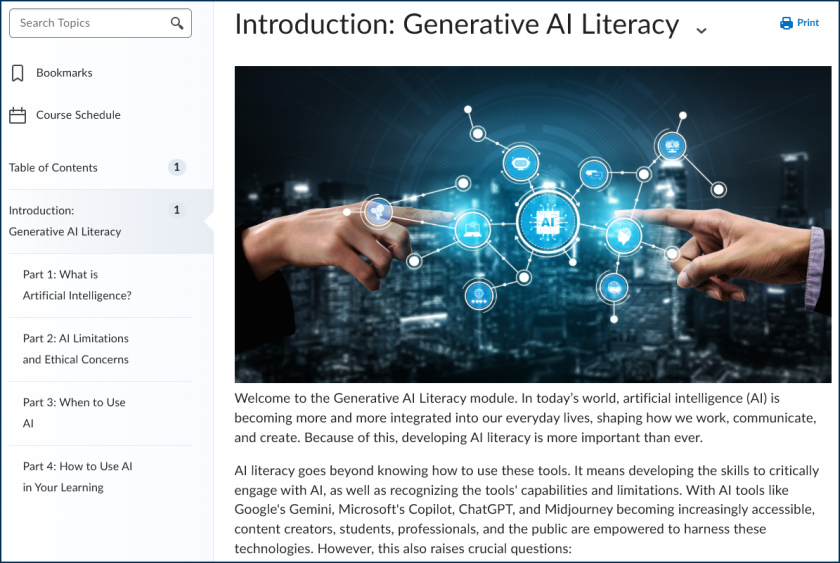
ai sandbox 1.1

Recipes – Sample Use Cases to Mix and Reuse

Ready-made Prompts – Short Examples for Teaching and Workflows

• “Create a module outline for a [discipline] course on [topic] that follows a structured learning path, including key concepts, activities, and assessments.”

• “Draft a course description for [course title] that is engaging, student-friendly, and aligns with accreditation requirements.”

• “I’m working to develop more creative ways for students to engage in online discussion boards in my upper-level undergraduate class on [insert subject]. I’d like you to provide suggestions on how to improve my prompts, my design of the discussion boards, and different ways to include more critical responses among students and different views posted on the board. I’ll give you my current prompts and I would like you to suggest ways to improve student engagement. Is that clear? What else do you need to know to complete this task?”

• “Summarize this academic article in plain language for undergraduate students.”

• “Generate a list of real-world examples that illustrate the concept of [topic] in [field].”

• “Create a short quiz (with an answer key) to test students’ understanding of [topic].”

• “Develop a rubric for grading student essays on [topic] that includes criteria for content, organization, and writing mechanics.”

• “Suggest alternative assessment methods for evaluating student learning on [topic] that incorporates best practices on AI resilience to make it more difficult for students to misuse AI and skip learning goals.”

• “I would like to create an assignment for a 200-level college course in C++ programming. The topic is [insert topic] — how to create class types, complete with data and member functions. One example assignment theme would be to create a class type which defined rational numbers (fractions), complete with member functions for the overloaded operators. Can you suggest three other possible themes, the goal being to develop a useful class type of a real-world thing we would like to represent abstractly?”

• “Create a debate prompt on [controversial topic in discipline] that encourages students to explore multiple perspectives.”

• “Draft an announcement for my course encouraging students to seek help with their assignments and highlighting available resources.”

• “Provide ideas for incorporating AI tools into student assignments ethically and effectively.”

• “Summarize key points from this meeting transcript and list action items, including task responsibility, who is best informed on relevant topics, and who the key decision makers are.”

“Reword this email to a student to make the tone professional and supportive, with clarity about my expectations.”

• “Suggest ways to make this reading assignment more accessible for students with disabilities.”