

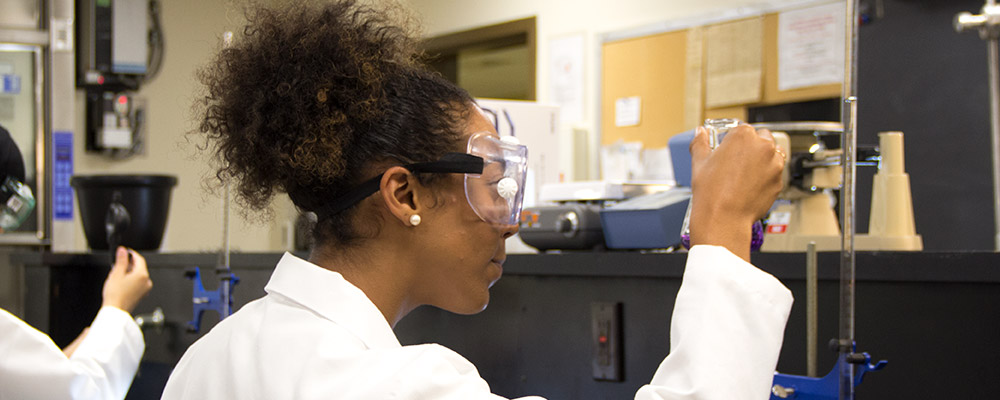
Experts in their field, the Biology professors at UMA are first and foremost teachers focused on the student. Combine that with UMA’s small classes and labs, and you’re guaranteed to receive the attention and career guidance you need.
If you’d like to combine a firm foundation in the liberal arts with an emphasis in the sciences, our Biology program is for you. Our courses in biology, chemistry, physics and mathematics will prepare you for advanced work in the biological sciences and allied health programs, while science electives will enable you to build expertise in an area of special interest.
Beyond course and lab work, the Biology department also offers the student opportunities to work directly with faculty on innovative scientific research projects, or intern at a collaborating institution such as Maine General Hospital, or volunteer in Haiti as part of a course in global health.
UMA’s Biology majors graduate with a broad spectrum of career options. Many of our graduates have obtained positions in laboratory science in both the public and private sectors and in education, while others have successfully pursued graduate study in the biological sciences, medical school, and in allied health programs leading to careers as a physician’s assistant or pharmacist.

“Faculty support has been exceptional. They do a great job molding the program to suit your needs. I have been able to focus my studies on my career goals and feel well prepared for the future.“
– Jamie Plummer, ’17
Sample Curriculum
Learning Outcomes
Upon completion of this program, students will:
- Demonstrate an understanding of science and its influence on society and the natural world in order to be responsible and reflective professionals by:
- Understanding that all living things have characteristics in common, share and evolutionary history, and belong to the biosphere.
- Understanding the importance of biological diversity
- Making informed assessments of the opportunities and risks inherent in the scientific enterprise
- Having a knowledge and skill base that enables them to continue to educate themselves about scientific and technological issues
- Having an understanding of the knowledge, skills and attitudes concerning the nature of scientific enterprise, integrative concepts, and the social and historical context of science
- Demonstrate competencies in the biological sciences to a level that prepares them for graduate programs or careers in the field by:
- Having an understanding of the methods and processes of scientific inquiry
- Understanding that cell structure, physiology, and biochemistry serve as a foundation for organisms in the biosphere
- Understanding the chemical basis of life
- Demonstrating technological proficiency and sound knowledge of safe laboratory practices
- Demonstrate quantitative and analytical skills needed by:
- Applying mathematic tools to analyze scientific problems
- Developing and analyzing experimental data sets
- Obtaining a basic understanding of statistics and statistical applications
- Demonstrating a quantitative understanding of experimental error and uncertainty