
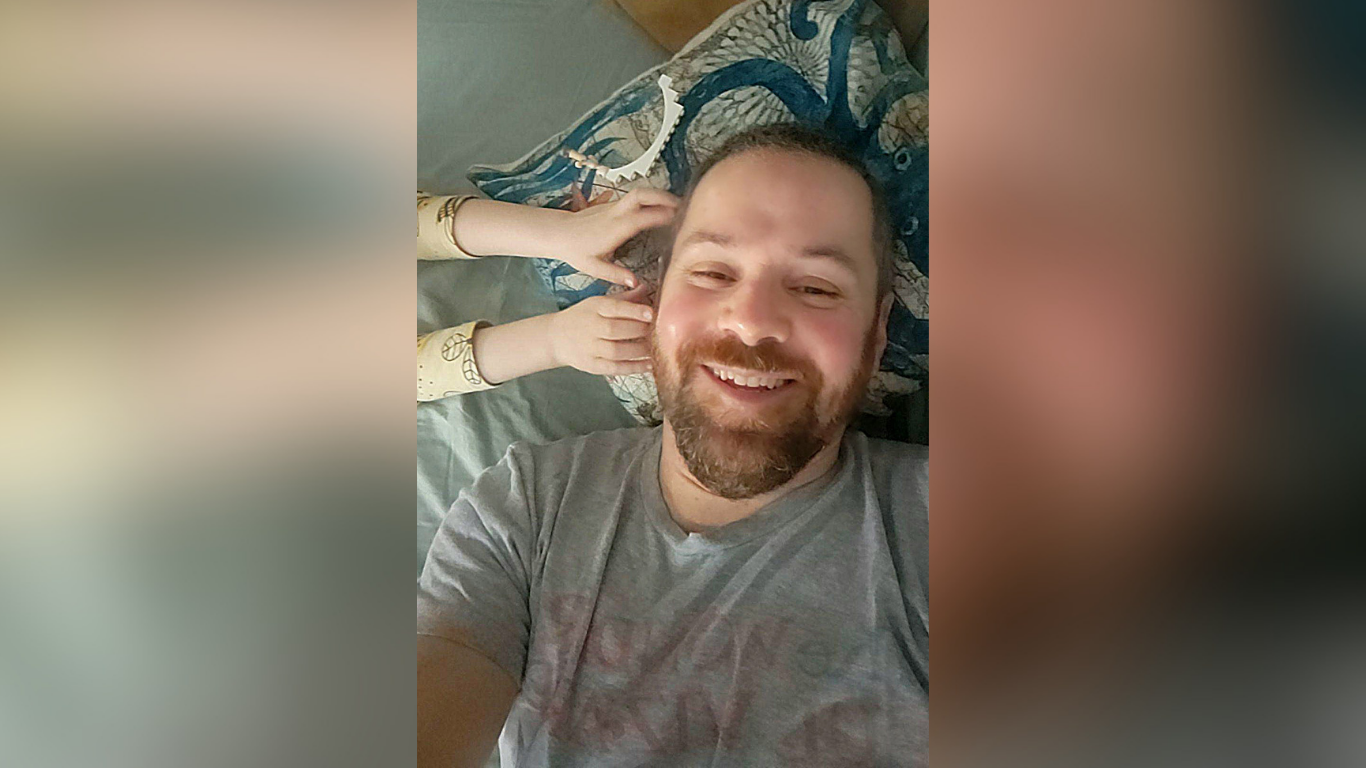
UMA Class of 2009
This alumni spotlight is reproduced in its entirety from “Ted Closson: A Visual Storyteller,” an “as told to” Q&A by Briana Waltman originally published in Specter Moose, UMA’s Literary & Art Magazine, Spring 2026, Issue 4. The full issue is available online. In the interview, Closson, a 2009 UMA graduate, reflects on how his time at UMA helped him connect technique, narrative, and personal vision as a writer and visual artist.
Ted Closson is a writer, artist, husband, and father living in Maine. He graduated from UMA in 2009 and later received his master’s from the University of Houston. He has published comics and other visual works in The Nib, Beyond: Queer Sci-fi and Fantasy Comics Anthology, Black Warrior Review, Hobart Literary Journal, The Rumpus, The Good Men Project, and Storychord. His work has been exhibited at the Museum of Modern Art (MoMA) in New York City.
How did attending UMA help you become the artist you are today?
I had a number of interests, and I was trying to find a way to connect them together. My bachelor’s was focused on technique. The main connective tissue between everything I was interested in was narrative. When I entered my master’s program, my focus became storytelling. I was making pictures and paintings but was not able to be succinct enough in my artist statements. I started to realize I was interested in so many different things that the only way to interact with all of them was through telling stories. There are narratives in everything. It is how we formalize those structures when telling a story. I have done a lot of memoir, and I am trying to move more into fiction because it is less easy to disrupt from outside sources. A personal narrative can be invalidated from someone else’s anecdotal experiences. Whereas, if you are able to connect to an audience through fiction, it becomes resilient. This is one of the subjects I did my master’s thesis on, this idea of stories being durable structures for carrying information.
At what point did you begin creating art? Who were your earliest influences?
When I got out of UMA was when I started really thinking about why I was making art and what I wanted to make. What you learn in a master’s program is how to articulate your internal world. You learn to speak about your art in the context of art history. My earliest influence as a result of that was, ironically, Scott McCloud, who is more of a theorist than an artist, known for his deep breakdown in 1993 of how comics work, playing off of the existing work of writer and artist Will Eisner, who he talks about in his book Understanding Comics. It’s come a long way. Anyone who understands how a sequential narrative functions is looking at more contemporary people. But those contemporary people are still answering to that history of McCloud and Eisner starting the groundwork. Now it is more complex. People ask, “Well, what can a comic be? What is its structure?” I asked these things in my master’s program. I could have studied this for years. Eventually I got out, and I had to [start creating] work.
It started with putting in the time to tell the story. Asking myself, “Is anyone going to care?” and I happened to stumble across The Nib. And around the time that I was making my to-do list notes to submit something to them is when my friend died. As 2017 progressed it became the worst year of my life. I lost my last grandparents that year and I also lost my son. Weirdly, when my son died, I found my voice. Because I realized I had an opportunity to speak to things that mattered to me. I am not going to truncate it. I was going to learn to say the complex things I needed to say as simply as possible. I became kind of fearless. They were things I wanted to document to avoid losing those memories. I try to cut through the noise so if someone looks at my work they find value in it. I could have talked about how I was in pain, but I didn’t feel like that was of use to anyone. I was trying to document it more for my wife and I—to explain my headspace during that loss.
You use your art to share personal experience and political themes. Will you share how you blend nonfiction realities with fantasy and mysticism?
I love to play around with elements of fantasy and mysticism. From an anthropological sense, it is key to our identities as human beings. So, they are structures that are resilient and that we all have a point of reference to for many of them. So, when you insert them into a story, they hold that meaning and you can change that meaning to your own personal commentary.
Your project “Beautiful Dreams” with MoMA seems particularly wonderful because of its collaborative nature– working within a specific theme of space exploration, delving into a historical analysis of science, culture, and architecture, resulting in phantasmagoria. How did that experience challenge you as an artist?
There are so many scams going on online, I didn’t think it was real. “Why would they approach me?” I thought. The really bizarre part is that I had just gone to the museum and two weeks later I was approached when they asked me to pitch a couple ideas. They liked the space proposal. They didn’t print everything I had to say about that stuff [misdirected energy of some aspects of humanity] and had some heavy editing. I didn’t end up in the main article. What I said that they left out was this idea of a fantasy that we could have had, that we might have lived, that we dreamed of– is so dead. It makes me angry that we did not clearly learn anything that we just kept making the same stupid mistakes.
Are you familiar with Cosmos at all? Karl Sagan? In Cosmos he explores this big picture of the development of our planet in timescales illustrating how brief the human time scale actually is. He tries to temper that ego we tend to have, particularly Americans. “The ship of the imagination.” In Carl Sagan’s Cosmos, it’s a dandelion. It’s a symbol of knowledge and hope. That is why I chose the image of the dandelion in the work in MoMA.
What suggestions would you give to emerging artists and writers who are still “coming out of their shells?”
Keep a journal, organize thoughts with sketches and writing. If you are sincere about the desire for meaning in your work, you are going to have to find a way to articulate that. And that takes a lot of building of the idea and filtering it down. Editing is where all the magic takes place. I spend an equal amount of time editing and making.
Someone once said, “Hell is the blank page for the creative person.” Working with computers is one way I have worked around that. It is not so important what you put down initially, but what it evolves into.
Find a way to frame the world around you. If you don’t have the time to draw or write every day, activate that observant part of your mind by journaling. Waiting for the stars to align for your creative ideas is not a good strategy. Warmups and making work every day is a great habit to have. One of the things I did in my original bachelor’s program was photography. This is a great way to train the eye in structuring things. If you don’t have the time to take an hour to draw, find a way to frame the world around you, thinking with that part of your brain.
Tips on becoming a great storyteller?
Learn to edit, learn to be succinct. Tell a story that means something to you. To tell something long, you are going to spend a long time with it and crawl over every nuance. Start small.
What about for the artists who want to move into art as a career?
If you aren’t making art that supports you, find a mindless job that pays the bills that is absolutely mindless so you can maintain your creative internal world. I used to write down notes to story ideas when working at a machine shop between the parts being cut. If you are thinking about what you want to create, then time is not being wasted. As you give your attention to your creative ideas, even if you are not producing anything, you are still refining those ideas for the time when you do get the ideas out. There’s a portion of the work that is done before it ever hits the page. You work through the problems of what you do and don’t want to do.
You can calculate the value of your time. You have spent years developing it, so you have to determine the value of your skilled time.
Figure out what you want to do with your creative process. Work on a body of work that is yours—and find a way to monetize your work. Build your portfolio.
It is a longer road if you have a personal vision. You have to explain to people why it is valuable.
What is the biggest responsibility of the artist?
I think we are meant to guide culture. Historically artists were teachers and shamans, people who led. We have been separated from that because images have become commodified. In my work I talk about grief, death, the environment, and condense it into an easy-to-carry internalized structure as it can be. I want to make something memorable. It can be a tool by which the viewer better understands their own perspective of the world. I think artists should be leaders, whatever leading means in that moment.
When writing I tend to go very bitter and very dark. And when I make the work, I try to cut that out so there is some element of hope. I see that as a duty of creative people. To try to guide people in the direction to bring us together in our understanding.