

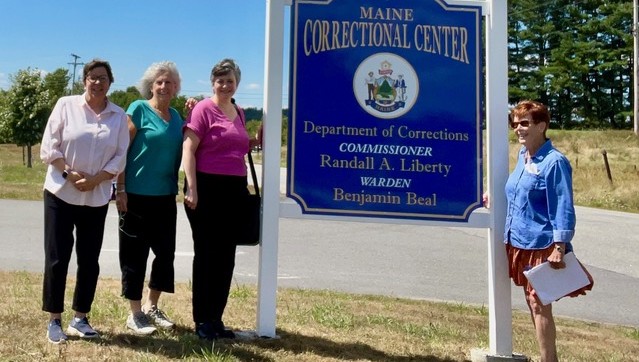
In a small room at the Windham Women’s Correctional Center, a group of women gathers each week to sing. For an hour, the noise of daily routines fades, replaced by shared breath, blended voices and a rare chance to be fully present.
This women’s choir offers more than music. It creates space for connection in a setting where isolation can be the norm. Through song, participants are reminded that their voices matter and that they belong to something larger than themselves.
The program was initiated by Dr. Christine Letcher, assistant professor of music at UMA and music director of the Church Organists and Directors Association (CODA) Chorus, and is supported by a growing circle of collaborators. CODA’s board president, Elise Klysa, worked closely with Letcher to develop and secure grant funding, and each week four CODA volunteers, sopranos and altos, join rehearsals at the facility. Their presence reinforces the choir’s sense of shared effort, modeling collaboration while singing alongside participants rather than leading from a distance.
A bridge back to themselves
Many participants describe the choir as a way back to who they are beyond their circumstances, a pattern reflected in studies showing that group singing in prisons helps people rebuild a sense of identity and self‑worth beyond their sentence. Singing together invites listening, trust and vulnerability. Each person shows up not as a number or a label, but as a human being in relationship with others.
That sense of belonging does not happen by accident. Rehearsals are structured to encourage collaboration and mutual support. Over time, the group finds its rhythm together, learning when to lead, when to follow and how to hold space for one another. One participant shared that singing helped her feel human again, a feeling she had not realized she was missing. This response is consistent with research finding that prison choir members report greater happiness, sociability and a renewed sense of being seen as fully human.
Music also becomes a way to process difficult emotions. Joy, grief, hope and uncertainty all have a place in the room. The act of singing gives those feelings somewhere to go, turning them into sound, harmony and shared experience.
“We approach this work as collaborators, not instructors,” said Letcher. “Together, we create a space grounded in dignity and connection. In the choir, women practice listening, leading, and trusting their own voices, and those strengths become part of how they see themselves and what they bring back home.”
Measuring what music makes possible
Alongside these personal moments, the program is intentionally gathering insight about its impact. Participants complete simple pre‑ and post‑tests that explore changes in social connection, mood and outlook, building on a growing body of evidence that music programs in carceral settings can reduce anxiety and depression while increasing resilience and social connection.
Over the next two years, this information will help shape a practical guide for other correctional facilities interested in starting similar programs. What is happening in Windham has the potential to ripple outward, offering a model rooted in dignity, access and care.
Songs that look forward
The choir’s repertoire reflects both comfort and possibility. This winter, participants are rehearsing familiar Disney songs that tap into memory and imagination. Last summer during the warmer months, the music turned toward a theme of sky and stars, songs that look upward and outward.
Rehearsals build toward moments of shared pride. The choir works in two seasonal projects each year, a Winter Choir project and a Summer Choir project, and each culminates in two performances. One performance is shared with fellow residents, and the other welcomes invited community members. Standing together and singing for an audience affirms the work they have done, both individually and collectively, transforming rehearsal into something witnessed and celebrated.
A quiet kind of transformation
While the choir operates independently, it reflects a broader commitment shared across UMA’s prison education work: meeting people where they are and creating opportunities for learning, expression and connection in places where access can change the course of a life.
At its heart, this choir is about access. Access to creative expression. Access to community. Access to the simple, powerful experience of being heard.
Through partnerships and grant support, including funding from Choral Arts New England’s Alfred Nash Patterson grant, and the Onion Foundation, the program continues to grow. Its impact is felt not in grand gestures, but in small, steady changes. A deeper breath. A steadier voice. A group of women finding harmony, together.