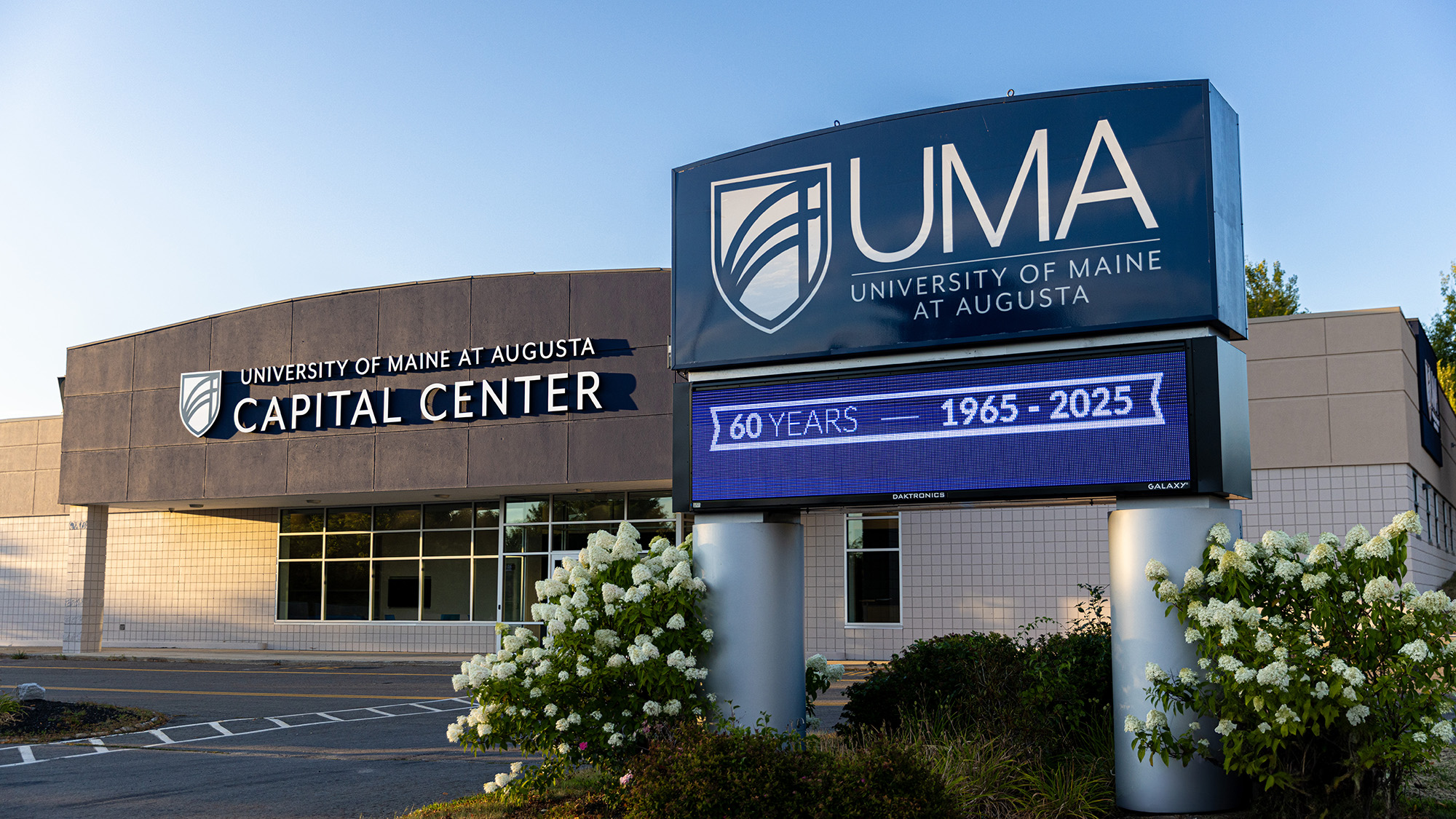

When Chloe Wilson walks into the University of Maine at Augusta’s new Capital Center for Nursing and Cybersecurity Workforce Development, it feels less like a classroom and more like the workplace she’s preparing to enter.
“Training in the new simulation labs feels like stepping into a real hospital,” said Wilson, a nursing student in the Class of 2026. “It gives me the confidence to know I’ll be ready to care for patients on day one.”
Her experience is echoed on the other side of the building, where graduate student Sarah Cook-Wheeler is sharpening her skills in UMA’s new cybersecurity lab. “The new cybersecurity lab lets us practice on the same kinds of systems we’ll be working with in the field,” she said. “It’s preparing me for a career where I know I’ll make a difference.”
Together, their stories capture the purpose of UMA’s newest investment — a 21,000-square-foot facility that opened this week with the support of Maine’s congressional delegation, state leaders, and community partners. The Capital Center combines cutting-edge nursing simulation labs, a 3,000-square-foot cybersecurity hub, and collaborative classrooms, giving students hands-on preparation for two of Maine’s most pressing workforce needs.
A ribbon cut with purpose
At the opening ceremony, U.S. Sens. Susan Collins and Angus King joined UMA leaders, the University of Maine System, and MaineGeneral Health to celebrate what many described as a forward-looking investment.
“The Capital Center represents UMA at its best, educating students with innovative tools and experiences that connect directly to careers,” said UMA President Jenifer Cushman. “It allows us to expand our programs, welcome more students and strengthen Maine’s workforce in health care and cybersecurity.”
The Capital Center is a $7.15 million renovation of the former Purdue Global site, made possible through congressionally directed spending in fiscal years 2023 and 2024 secured by Sen. Collins, chair of the Senate Appropriations Committee, and Sen. King at the request of the University of Maine System (UMS). Additional support of $480,000 from MaineGeneral Health is helping UMA expand its nursing program to take full advantage of the new facility and prepare more nurses for Maine’s workforce.
For Collins, who helped secure the federal funding, the impact is clear. “Maine’s future depends on expanding our highly skilled workforce, especially in fields like health care and cybersecurity,” she said. “I was proud to secure federal funding for the UMA Capital Center, which will increase opportunities for students to gain the hands-on training they need to succeed in these critical roles.”
King echoed the sentiment, calling the center “a powerful example of what happens when we invest in innovation and work together to meet 21st century challenges.”
Building cybersecurity talent
For UMA’s cybersecurity program, the new lab marks a dramatic step forward. What was once a single classroom has become a modern training space equipped with the tools to mirror real-world systems and provide workshops for Maine businesses and municipalities.
“Cybersecurity is one of the fastest growing fields in the country, and Maine needs skilled professionals to keep our businesses, municipalities and communities safe,” said UMA Professor Henry Felch. “This new lab gives our students the kind of training they will experience in the workforce and prepares them to lead in a field where the stakes are high.”
Cook-Wheeler sees the difference already. “It’s preparing me for a career where I know I’ll make a difference,” she said.
Meeting the nursing shortage head-on
On the health care side, UMA’s nursing program has grown from 91 students in 2019 to 271 in 2024, with capacity now expected to reach more than 400 within four years. That growth comes at a critical time: Maine is projected to face a shortage of more than 2,800 registered nurses by 2030.
“Every simulation and lab experience in this new space will ensure our students are practice-ready upon graduation,” said UMA Director of Nursing Shannon Gauvin. “With expanded capacity and the latest technology, we can educate more nurses who are confident, compassionate and ready to deliver excellent patient care to all of the communities we serve.”
Community partners see the impact too. “MaineGeneral is proud to partner with UMA on this project,” said Chief Nursing Officer at MaineGeneral Health Jennifer Riggs. “The Capital Center makes it possible for more students to access high-quality training, and our community will benefit from more well-prepared nurses entering the workforce.”
A future-focused campus
The ribbon cutting brought together leaders, partners, faculty and students for tours and demonstrations showcasing the new training opportunities. Classes begin next week.
To further support student growth, UMA is partnering with Mastway Development on a new residence hall in nearby Hallowell, set to open in fall 2027. The facility will add 60 beds and a dining hall, expanding UMA’s ability to offer a vibrant residential experience alongside its workforce training.
For students like Wilson and Cook-Wheeler, the Capital Center is already more than a building. It’s a place where their futures, and Maine’s, come into sharper focus.