
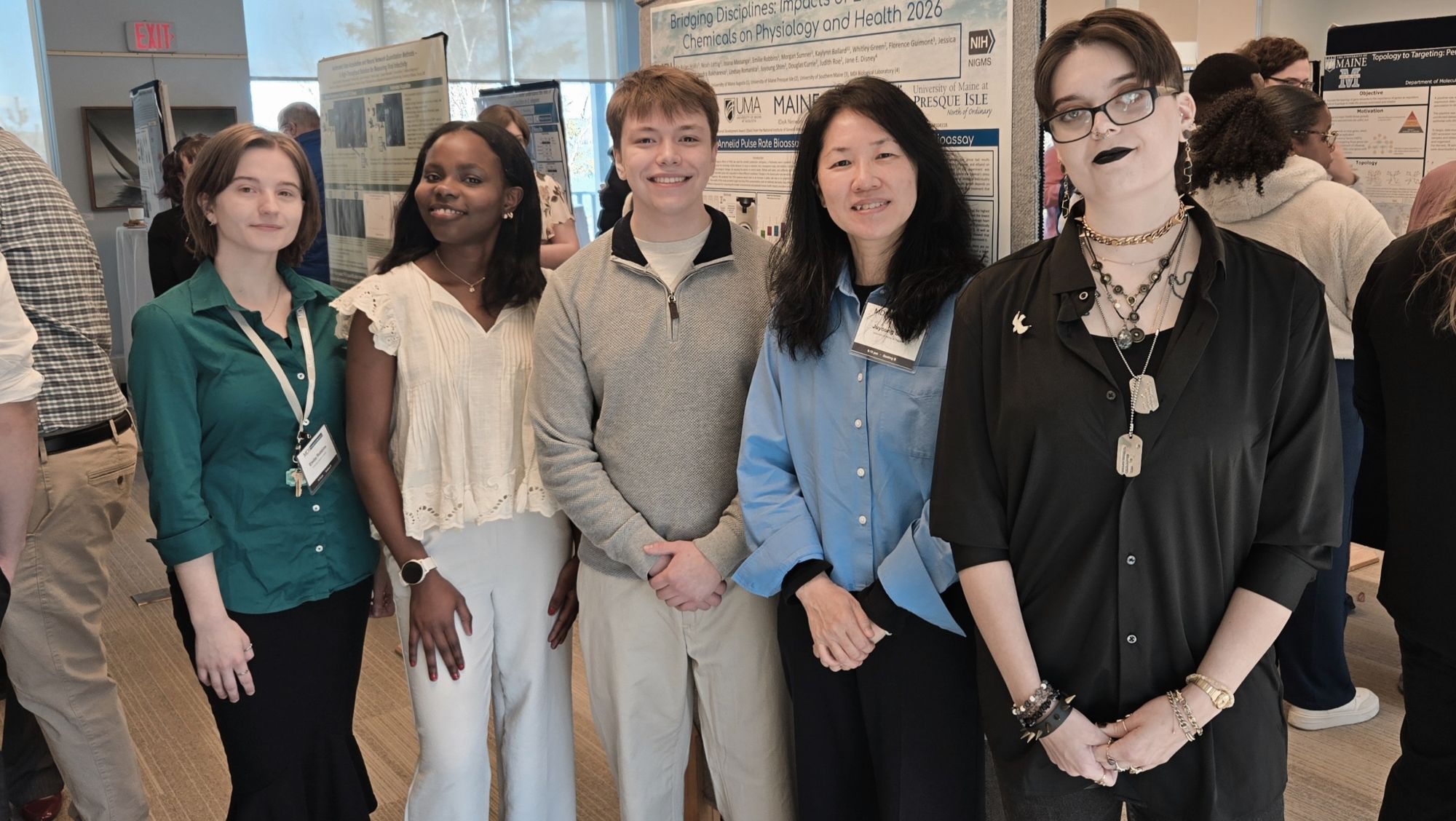
Students from the University of Maine at Augusta brought their spring break research to a statewide audience, presenting findings at the 53rd Maine Biological and Medical Sciences Symposium (MBMSS) on April 25.
The students had spent the week of March 15–20 at the MDI Biological Laboratory (MDIBL) in Bar Harbor, completing Bridging Disciplines: Impacts of Environmental Chemicals on Physiology and Health, an intensive, hands-on biomedical research course offered during spring break. Over five days, they worked alongside faculty from UMA, the University of Southern Maine, and the University of Maine at Presque Isle, immersing themselves in environmental toxicology. Using model organisms such as zebrafish, Drosophila, planarians, and annelid worms, students conducted bioassays (laboratory tests that show how organisms respond to substances) to study how exposure to environmental contaminants, including arsenic and PFAS, affects living systems and what those effects reveal about human health.
The course is taught by Dr. Juyoung Shim, associate professor of biology at UMA, and is supported by the NIH Maine IDeA Network of Biomedical Research Excellence (INBRE) grant. Dr. Shim, who also co-organizes the MBMSS, accompanied students to the symposium.
The annual event draws researchers and students from across Maine, including Bowdoin, Bates, Colby, institutions throughout the University of Maine System, and the Jackson Laboratory. For UMA students, presenting in that setting meant more than sharing results: it meant articulating their work clearly to expert audiences, fielding substantive questions, and seeing how their findings fit into broader conversations about environmental health in Maine.
Model organisms are a cornerstone of modern biomedical research, and the data generated even at the undergraduate level can inform future studies and contribute to Maine’s understanding of environmental health challenges. UMA’s commitment to placing students inside real research, with real collaborators, real methods, and real stakes, is a reminder that rigorous, meaningful science is not the exclusive domain of large research universities.