

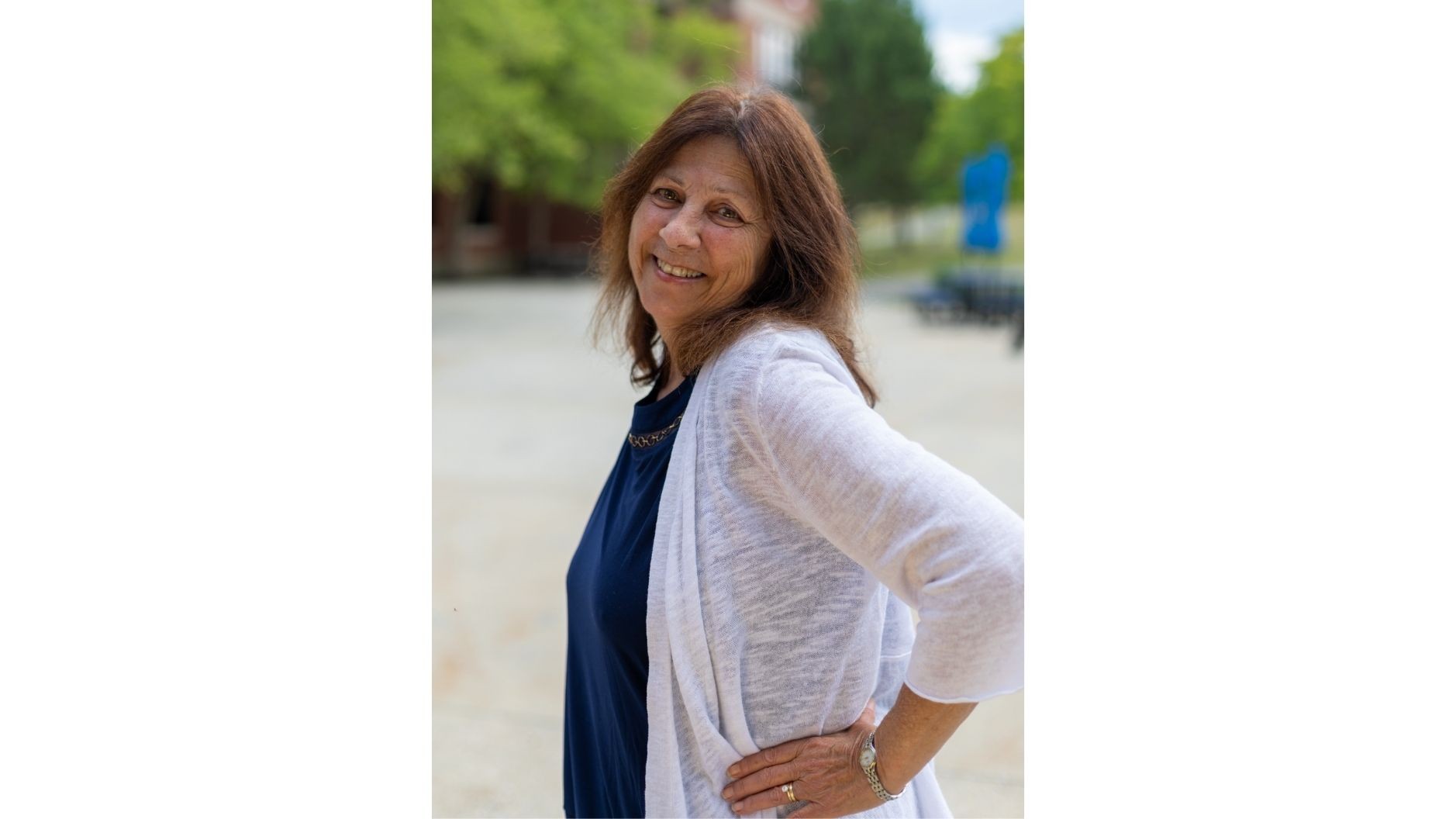
As Amy Line, Director of Military & Veterans Services, retires from the University of Maine at Augusta, her impact can be felt across programs, spaces, and generations of students. Her career unfolded alongside UMA’s own evolution, shaped by a shared commitment to meeting people where they are. Through times of growth and change, Amy consistently translated compassion into action, helping the university strengthen and expand its support for veterans and other students navigating transition. The structures she helped build and the culture of care she championed continue to shape how UMA supports students today, extending her influence well beyond her years of service.
That instinct first took shape during her 20-year career in the U.S. Navy. As an air crewman, Amy logged more than 5,000 flight hours aboard C-130 aircraft, flew P-3s for the Naval Research Laboratory, and served on helicopters. She did so at a time when women were still uncommon in those roles, earning responsibility through competence, steadiness, and trust. The work was demanding and mission-driven, but it was also deeply relational, requiring reliance on the people beside her.
When her military service concluded, Amy chose a new path, enrolling at the University of Maine at Augusta in 1998. She graduated in 2001 with a degree in mental health and human services and received the Distinguished Student Award that year.
Yet she has often reflected that the transition from military life to the classroom was not simple.
She was smart, capable, and successful, but after years of military intensity, she found herself restless. “I might have made very different choices,” she has said of that time, “if not for the people who noticed, who encouraged me to get involved, and who understood what veterans were navigating.”
At the time, UMA did not yet have a formal military or veterans services program. What it did have were faculty, advisors, and staff who paid attention. They invited Amy into student government, the honors program, and campus life. They helped her feel anchored during a period of enormous transition. That experience would shape everything that followed.
After graduating from UMA, Amy earned her master’s degree from Boston College, where she worked in research and practiced in the mental health and human services field. When she was invited to return to UMA as an adjunct instructor, she brought something especially powerful into the classroom. She paired academic knowledge with real-world experience, offering students insight grounded in both theory and practice.
She began teaching at UMA centers in 2004 and later on the Augusta campus, where students quickly recognized her authenticity and approachability. Amy was one of the few instructors who had lived the transitions she was helping students understand.
As her professional role at UMA expanded, so did the university’s vision for serving military-connected students. During the height of Operations Enduring Freedom and Iraqi Freedom, many Maine National Guard members were deploying, returning home, or attempting to continue their education from overseas. It became clear that access alone was not enough.
“We realized UMA needed to do more than simply welcome veterans,” recalled Jonathan Henry, vice president for enrollment management. “We needed to reach out to them wherever they were and make sure they knew UMA was here for them and their families.”
Working closely with colleagues across the university, Amy helped turn that understanding into action. She supported outreach to deployed troops, worked with families through mobilization and return, and helped build systems that allowed students to remain academically connected while serving. Those early efforts laid the foundation for what would become UMA’s Office of Military and Veterans Services.
Under Amy’s leadership, the office evolved into a comprehensive support system rooted in care, professionalism, and respect. She guided veterans, service members, and military families through benefits navigation, academic planning, and moments of personal challenge. Students were not treated as transactions or cases. They were met as people continuing a life of service in a new form.
President Jenifer Cushman later reflected that Amy’s leadership helped shape the office into something far more meaningful than a set of services. Through intention and consistency, it became a community where military-connected students felt seen, valued, and supported.
Amy’s impact reached far beyond campus. She was instrumental in building a statewide network of partnerships that included the Department of Veterans Affairs, the Maine Bureau of Veterans’ Services, the National Guard, and the Maine Military and Community Network. Those relationships ensured that UMA’s students had access to support across Maine, not just within the university.
Her ability to translate vision into tangible support was especially evident in her work to create dedicated space for veterans on campus.
As veteran enrollment grew following the expansion of post-9/11 GI Bill benefits, existing space in the Randall Student Center no longer met students’ needs. Amy played a central role in articulating why space matters for veterans navigating transition and community reintegration. She helped develop grant proposals that emphasized visibility, access to daytime services, and the importance of a shared gathering place.
That vision continued to grow. Earlier, in 2009, UMA had received a $100,000 grant from the Walmart Foundation to strengthen veteran support, the only university in New England selected. Amy was hired to help implement the grant’s goals, which included peer support initiatives, entrepreneurial training, and the creation of UMA’s first Veterans Academic Center.
As demand grew, Amy recognized the need for a more supportive and purpose-built space for veteran students. She led the effort to secure philanthropic support, and in 2016, the University of Maine at Augusta received a $50,000 grant from the Fuller family’s Windover Foundation to help create the Veterans Academic Center in Katz Library. A Navy veteran and UMA alum, Amy shaped the vision for a space where veterans could connect, access services, and find understanding throughout the day. She is quick to acknowledge the role of Retired Capt. Robert G. Fuller Jr., JAGC, USNR, a Windover Foundation board member, whose personal commitment and veteran-informed insight helped guide thoughtful design and accommodations that support the veterans well-being and connection.
In 2017, the current Veterans Academic Center opened in Katz Library, made possible through the generosity of retired Captain Robert Fuller and shaped by Amy’s sustained advocacy, outreach, and planning. Today, the VAC stands as both a physical space and a symbol of UMA’s commitment to those who have served.
Throughout her tenure, UMA earned recognition as a Military Friendly Institution for 15 consecutive years. Amy consistently emphasized that such recognition was not an endpoint, but a responsibility that required ongoing attention and care.
In 2022, she received the Quilt of Valor at the Maine Military and Community Network conference, honoring both her military service and her continued advocacy for veterans. For those who worked alongside her, the recognition reflected a lifetime of quiet, steady dedication.
Over more than 20 years at UMA, Amy watched students become graduates, graduates become colleagues, and early ideas grow into enduring institutions. Her impact is visible in programs and spaces, but it is felt most powerfully in the lives of those who found confidence, stability, and belonging during moments of transition.
When asked to reflect on her legacy, Amy returned to a phrase that has long guided her work. “The legacy of the past forges the future.” It is both a reflection and a responsibility. The systems she built, the partnerships she nurtured, and the culture of care she modeled now belong to the entire UMA community. As Amy steps into her next chapter, the work continues, shaped by her example and strengthened by her belief that service, when grounded in compassion, creates lasting change.