
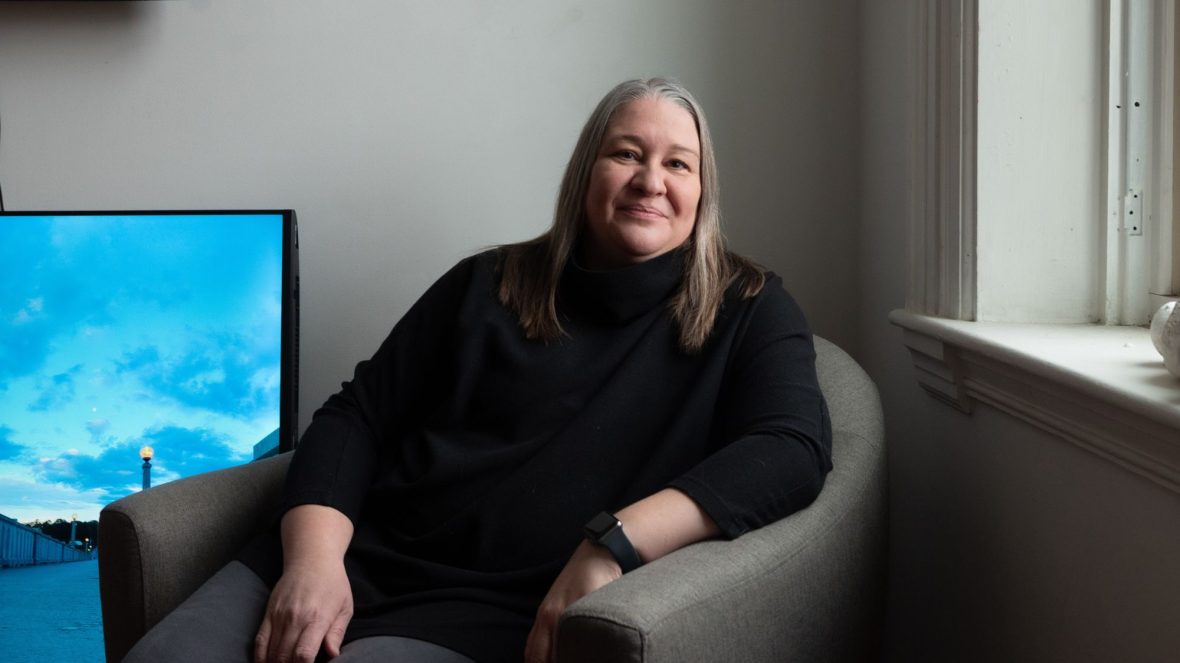
This faculty spotlight is reproduced in its entirety from “An Interview with Multi-Media Artist Bethany Engstrom,” by Diamond McGrath, originally published in Specter Moose, UMA’s Literary & Art Magazine, Spring 2026, Issue 4. The full issue is available online.
In this interview, we look at the creative journey, teaching style, and artistic growth of Bethany Engstrom, a longtime UMA art professor. She is known for her video installations, curatorial work, and use of experimental materials. Her story shows how curiosity, mentorship, exploration, and observation can lead to lasting, impactful art. As a teacher, she encourages her students as budding artists to explore, try new things, and trust their creative instincts.
Early Life and Path into Art
Bethany did not grow up surrounded by art. She became interested in high school when a teacher encouraged her to keep creating and believe in her ideas. Even with this support, she did not feel ready to study studio art right away.
Instead, she started college as an art history major, learning about artistic traditions and changing ideas. After graduating, she worked in museums, traveled, and saw the art world from the outside. Seeing many types of art, from traditional to experimental, inspired her to go back to school and experiment with her own work.
UMA and the Value of Community
Bethany completed her undergraduate studies at UMaine and has since built a strong connection to UMA through her teaching. She says UMA is a place where students from many backgrounds – such as veterans, older adults, incarcerated learners, young parents, and first-generation students – make the classroom lively and interesting.
In her classes, students bring different life experiences and viewpoints, creating a space where ideas mix in surprising ways. Even in online courses, their openness and curiosity make the work meaningful. Being part of UMA’s art community, as both an artist and a teacher, is still one of the best parts of her career.
Entering the World of Artmaking
Bethany gradually transitioned from the realm of art history to creating her own art over a period of time. While working at the Farnsworth Museum, she saw a major exhibition by Matthew Barney that combined sculpture, video, performance, and installation. This show changed how she saw art and inspired her to go to graduate school to focus on her own work.
Creative Practice and Daily Life
For Bethany, art is part of her everyday life. Ideas come to her while driving, teaching, curating, or noticing something unexpected. She says that these small moments, whether surprising, confusing, or beautiful, are central to her work. They make her stop and think, “Oh… I wouldn’t have thought of that, but now I get it.”
Teaching gives her a constant flow of creative energy and inspiration. Watching students complete assignments, use different materials in different ways, and find their own voices inspires her to keep growing in her own art. Curating also shapes how she thinks as she considers how to present work, how viewers interact with it, and how different/specific materials communicate different meanings.
Working with Video and Time-Based Media
Bethany tried video early in her career, but it became her main medium after she began attending artist residencies in 2019. She loves how video can capture time, such as a gesture, a sound, or a quick moment, in ways that still images cannot. Video lets her record actions without a live performance, while still preserving the movement, sound, and feeling within her work.
She tells students to make a “video database” by filming one-minute clips of daily life. She does this herself to collect material for future art installations.
Materials, Experimentation, and Evolving Ideas
Bethany’s work is very experimental. She has used materials like water, salt, wood, and other everyday things, changing them as her ideas grow. When a material no longer works for her, she tries something new.
In a recent project, she made sculpted mounds of salt, each weighing about fifty pounds, and placed them on a copy of her studio table. Each mound has a tube pointing down that shows a video hidden under the salt. The piece needed careful planning to hide the video inside. The result is a simple, elegant design that draws viewers in as they lean closer to see what’s hidden underneath the surface.
She says the first time she looked down the finished tube was “glorious;” the feeling was like finishing a puzzle and seeing the whole picture.
Inspiration and the Creative Spark
Bethany finds inspiration in her day-to-day life, unexpected things she notices, and small moments that make her think. Sometimes inspiration comes from solving problems, like being stuck, trying something new, and finding an answer. She sees these “aha” moments as some of the best parts of being an artist.
Future Directions
Her work changes as she tries new materials and technologies. Lately, she has used drone footage to see how views from above might shape her future art installations. She does not plan far ahead, but ideas about care, the environment, and daily life still guide her work.
Advice for Emerging Artists
Bethany often shares John Cage’s “10 Rules” with her students and highlights the most important one: do the work. She tells them to show up and create, even when they feel stuck or afraid of failing. She believes failure is part of learning, not a real setback.
She urges students to take every chance they get, like going to artist talks, exhibitions, workshops, and any experience that helps them learn more about art.
Memories of UMA
Bethany’s favorite UMA memories are showing her work in campus galleries and meeting faculty and students before she started teaching. Being part of this community, both locally and on campus, helped shape who she is as an artist and teacher. Now, as a professor, she values the chance to inspire students the way her high school teacher inspired her.
Conclusion
Bethany Engstrom’s story shows how important curiosity, trying new things, and having a community are. From discovering art in high school to building a career in teaching, curating, and multimedia installations, she continues to explore and expand what art is to her and what it says about time, culture, and experience. At UMA, she helps students find their creative voices, carrying on the tradition of mentorship that shaped her own journey.