

Currently Accepting Applications!
UMA’s Bachelor of Science in Nursing (BSN) prepares you to become a skilled, compassionate nurse ready to meet Maine’s growing healthcare needs.
With a holistic, evidence-based approach and hands-on clinical experience, you’ll build the knowledge and confidence to succeed in today’s healthcare environment.
Now expanding access in Fall 2026: Students can complete the nursing program at UMA’s Lewiston Center.
UMA’s Nursing program will:
- provide you with a quality baccalaureate-level education,
- enhance your abilities to sustain caring nursing practice within the complex and dynamic healthcare environment,
- allow you to develop the leadership and management skills necessary to promote growth within the profession of nursing, and
- provide you with the educational foundation for graduate-level nursing education.
Upon successful completion of the traditional 4-Year curriculum, UMA awards a Bachelor of Science degree with a major in Nursing. Upon degree completion, students are eligible to take the National Council Licensure Examination for Registered Nurses (NCLEX-RN).
UMA’s nursing program is designed to meet students where they are, with flexible access points across Maine.
UMA is consolidating nursing program delivery to strengthen student experience, expand access in key regions, and align with Maine’s workforce needs.
Primary locations include:
- Augusta (Capital Center for Nursing and Cybersecurity Workforce Development)
- Lewiston (starting Fall, 2026)
- Ellsworth
- Rockland
Now Available in Lewiston
Starting Fall 2026, students can begin and complete their nursing degree through UMA’s Lewiston Center.
- Learn close to home
- Access full student support services
- Complete clinical experiences in regional healthcare settings
Downeast Nursing Track
(UMA + UMaine Machias Partnership)
The Downeast Nursing Track, a collaborative partnership between the University of Maine at Machias and UMA, allows you to earn both a Bachelor of College Studies and a Bachelor of Science in Nursing (BSN) while staying in the Downeast region. Designed to meet students where they are, this pathway combines flexible coursework at UMaine Machias with online nursing education through UMA. Students benefit from hands-on lab and simulation experiences at the Ellsworth Center and local clinical placements, making it possible to prepare for a nursing career without leaving your community.
Additionally, the Nursing Program offers a residential opportunity in partnership with the University of Maine at Farmington. Students will be enrolled in UMA’s program while taking courses from both UMF and UMA, and enjoying a residential campus experience at UMF.
Capital Center for Nursing
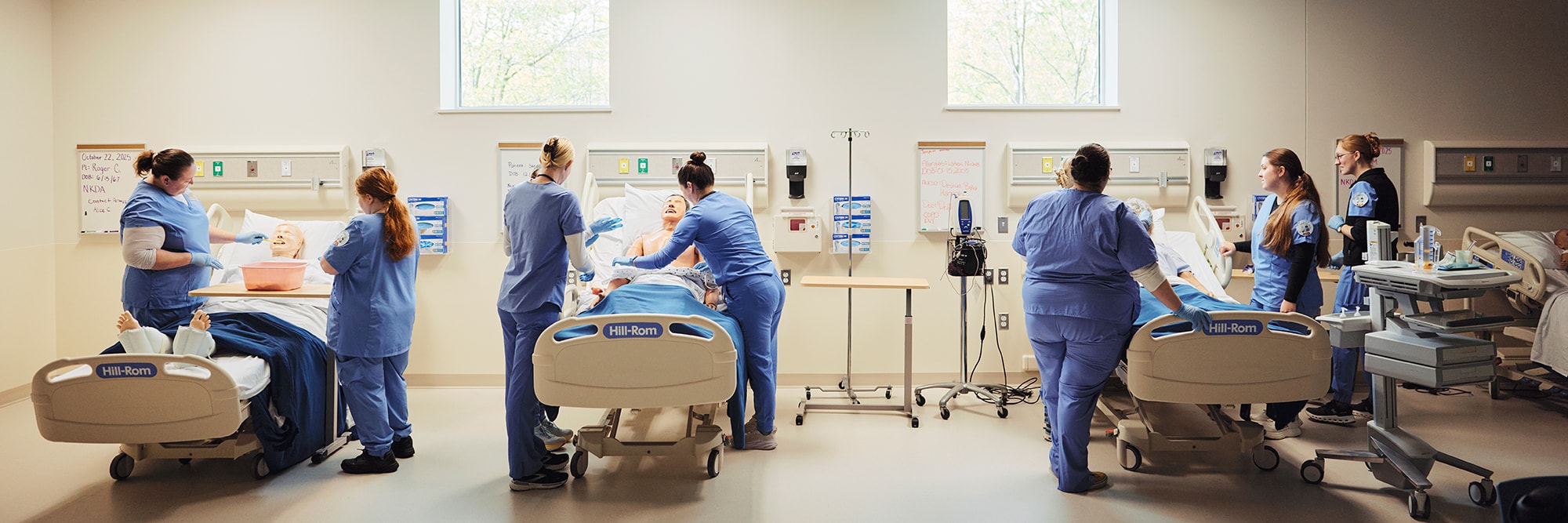
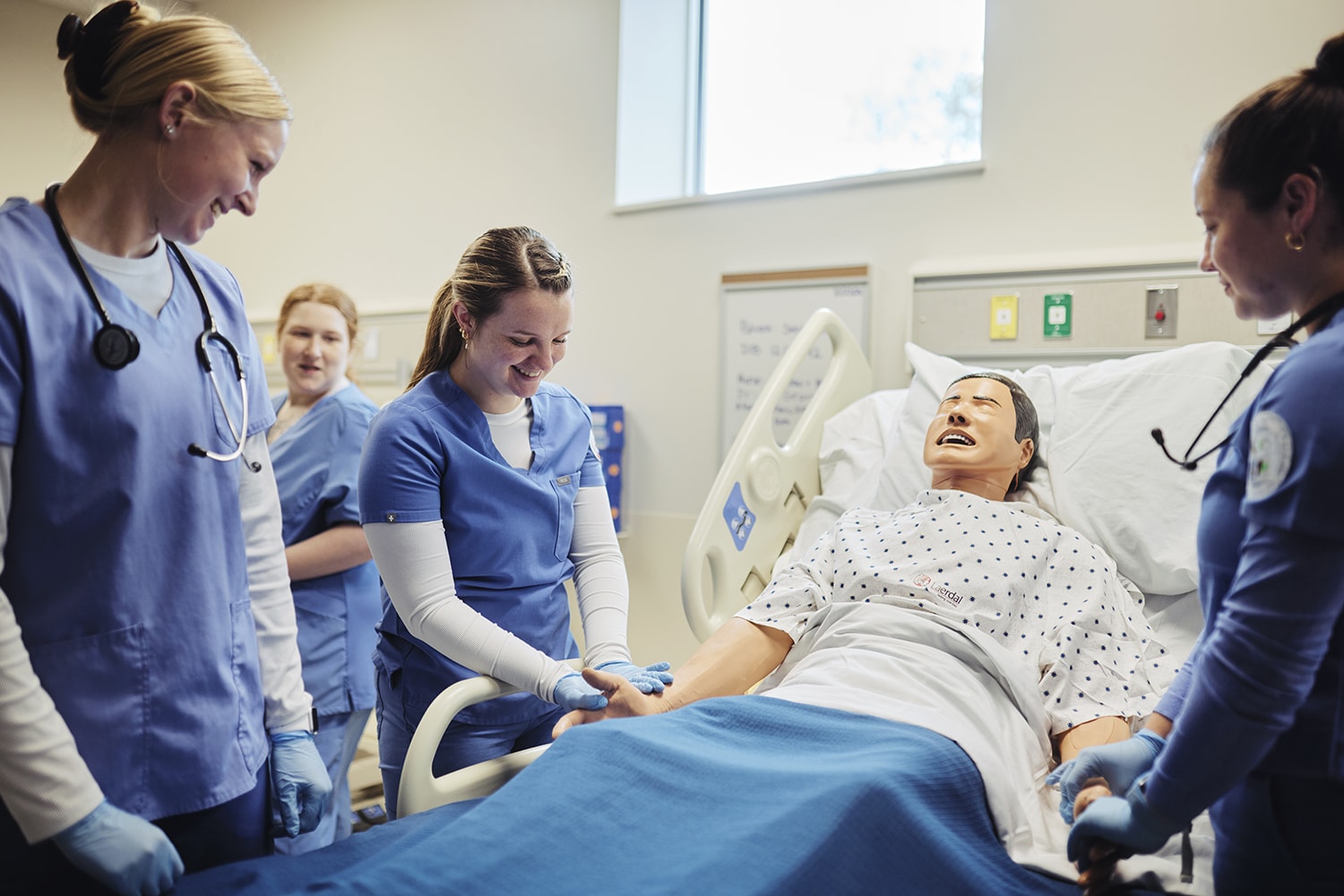
The UMA Capital Center, located in Augusta, features fully equipped simulation labs and clinical educations spaces built to prepare nursing students for the realities of patient care. Learning continues beyond campus through UMA’s network of healthcare partners across Maine, giving students direct clinical experience in the communities they’ll one day serve. Our longstanding relationship with MaineGeneral Health and other regional facilities ensures that hands-on practice is woven into every stage of your nursing education.
Explore these tabs to learn more about the BSN Program
BSN 4-Year Pre-licensure Track Admission Requirements
Application Deadline: January 31st for Fall Entry and November 15th for Spring Entry
All new applicants who do not meet UMA’s Nursing program requirements can be admitted to pre-nursing status to gain eligibility. UMA offers admission to the nursing program twice each year for both fall and spring entry. Applicants who apply to the Nursing program before November 15th will be notified by December 15th of a spring admission decision. Fall applicants who apply by the January 31st deadline will be notified by March 15th of a fall admission decision.
To be admissible to the UMA 4-year Bachelor of Science in Nursing (BSN) program, applicants must complete the following requirements (subject to change):
- Two High School or College-level Science with Lab courses with a grade of B (not B-) or higher within the last ten years
- Cumulative GPA of 3.0 or higher
- Applicants who previously attended a school of nursing must be in good standing and eligible for readmission at their current/former school of nursing. Any student who was dismissed from a school of nursing must complete the BSN Supplemental Admissions Essay:
Additionally, as this is a rigorous program, applicants’ prior English and math course grades will be holistically reviewed to ensure applicants have the necessary foundation for academic success. Applicants may not be offered admission if it is determined they do not have the foundational English and math skills required for enrollment. *NOTE: Science and math courses must be completed within the previous 10 years to be considered for admission review.
The nursing program is a lock-step curriculum, meaning each semester of courses builds on the previous semester of courses.
UMA Bachelor of Science Nursing 4-year Sample Curriculum
Courses are subject to change. View the official UMA Catalog here.
Program Student Learning Outcomes
Upon completion of the Nursing Education Program the learner will:
- Demonstrate holistic-relationship centered nursing care in diverse health care settings.
- Use best current evidence to provide safe and effective holistic nursing care.
- Use critical thinking skills to assess cultural, ethical, legal, and safety concerns with diverse client populations across the lifespan.
- Utilize technology and information to monitor outcomes of holistic care and to improve the quality and safety of healthcare systems.
- Develop one’s professional identity with an ability to partner within an interdisciplinary team in order to continuously improve care.
- Effectively communicate through technological, written, and verbal modalities.
- Demonstrate transformative leadership skills in influencing healthcare care delivery systems.
- Demonstrate competency with self-care-healing modalities in order to create sustainable caring-healing practices.
- Create a plan for continued professional development and commitment to lifelong learning.
- Develop health promotion and illness prevention skills for patients and communities via contemporary approaches to wellness through the coaching role of the nurse.