RN to BSN Completion

Earn your BSN at UMA

The Bachelor of Science in Nursing (BSN) is rapidly becoming the preferred educational credential for registered nurses, and we’re honored to support students with an affordable, flexible path to this distinction.

100% online

Maine’s only holistically-endorsed nursing program

Flexible & asynchronous

Nursing RFI
Name
Name
First Name
Last Name

Designed for working RNs

Because most RN-to-BSN completion students are working nurses, this program is 100% online and asynchronous. Our faculty is here to provide any support you need, and are available during their scheduled office hours—live, and virtually. This program will:

  • Establish an educational foundation for graduate-level nursing education
  • Provide you with a quality baccalaureate-level education
  • Enhance your abilities to sustain caring nursing practice within the complex, dynamic healthcare environment
  • Allow you to develop the leadership and management skills you need to grow in your profession

What is holistic nursing?

Holistic nursing is a specialized, relationship-centered approach that treats the whole person—mind, body, spirit, and emotions—rather than just focusing on a specific illness or symptom. It bridges conventional medical practices with complementary therapies to promote healing and wellbeing, involving the patient as an active partner in their health journey. We believe that in order to effectively care for others as nurses, we must also practice self-care, mindfulness, and self-reflection. Our curriculum integrates holistic practices at every level, shaping how students learn, reflect, care for patients, and care for themselves.

Holistic Nurse Certification Exam

We’re Maine’s only holistically-endorsed nursing program, a distinction we share with just 16 other schools across the country. That means our students graduate prepared—and eligible—to take the HNB-BC and become a Certified Holistic Nurse—a notable career differentiator.
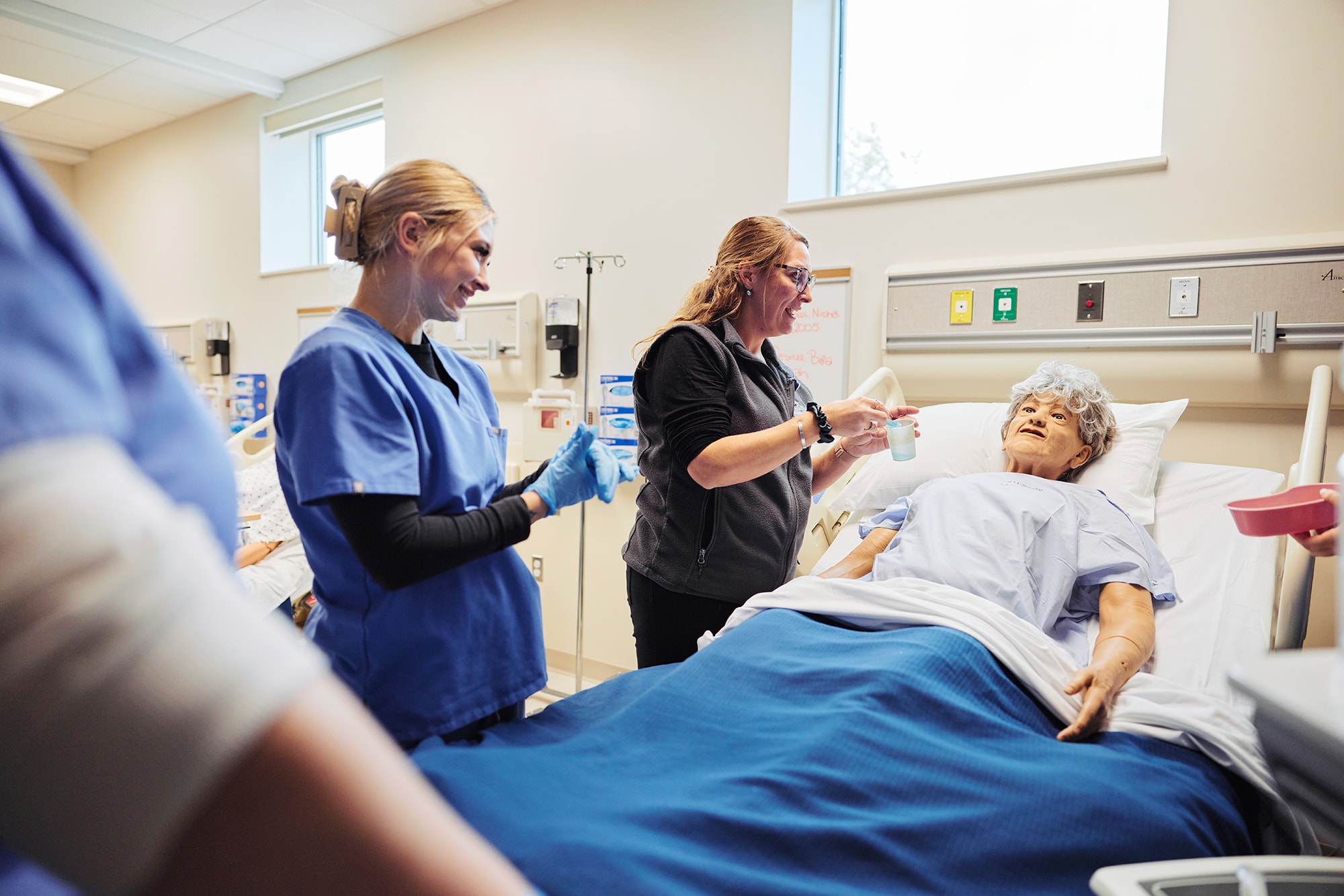
uma student watches faculty administer medication in sim lab

Your path to leadership

While all prelicensure students must travel to Augusta occasionally to meet program requirements, UMA offers the greatest spread of access points across Maine.

Holistic nursing focuses on self-awareness, personal growth, and self-care. Leaders who practice these principles are better equipped to mentor staff, manage team resilience, and prevent workplace burnout.

Students are trained in active listening, trauma-responsive care, and cultural humility. These skills are vital to supporting patient wellbeing, and for mediating between patients, families, and healthcare teams.

Learn more about UMA’s RN-to-BSN

RN to BSN Program Admission

With UMA’s public tuition rate, you will pay less than at any other RN to BS in Nursing program in the state. Plus, UMA will award you up to three credits for selected nursing certificates you may have already earned – that’s an additional savings of over $600. At the same time, UMA’s program offers a high quality education that meets all the standards mandated by the Accreditation Commission for Education in Nursing (ACEN).

Admission Requirements

In order to be admitted into the RN-BS in Nursing Completion program option the prospective student must have the following.

  • Associate Degree in Nursing (from a nationally and regionally accredited institution)
  • Active RN license (must be completed before the second semester in the program)
  • Minimum cumulative GPA of 2.50 from all regionally accredited institutions attended (if minimum GPA requirement is not met, you may elect to be admitted into the BS in Liberal Studies program and take non-nursing general education courses until the GPA reaches 2.5)

Note: If transfer students have not completed the courses listed below at their former college, they need to complete UMA’s core education requirements before receiving a degree from UMA.

  • BIO 110 Fundamentals of Biology or equivalent
  • BIO 210 Anatomy & Physiology or equivalent
  • BIO 321 Microbiology or equivalent
  • COM any 100-level Communications course
  • ENG 101 College Writing
  • Fine Arts or Humanities elective
  • MAT any 100-level or higher Mathematics course
  • PSY 100 Introduction to Psychology
  • PSY 308 Human Development
  • SOC 101 Introduction to Sociology

Admission Process

A candidate for admission must complete the UMA application and pay associated fees. For complete UMA admission policies please refer to the current on-line catalog. For specific questions regarding the nursing program please contact either the Administrative Specialist or the Academic Program Coordinator. Once applicant’s file is complete and all requirements are met, the applicant will be notified by letter whether the application has been accepted or denied. After receiving a letter of acceptance, which lists a nursing faculty advisor, students are encouraged to contact their advisor as soon as convenient to set up an appointment to discuss program progression and graduation date goal.

Prior Learning Assessment

Course credits can be earned in the following ways: Credit by Examination, Portfolio Review, and External Training Review – Students can be awarded 3 NUR elective credits for current national certification in the following areas: See RN Nursing Certifications for a complete list. See Prior Learning Assessment for more information about all the avenues by which UMA accepts credit for prior learning.

Questions? Contact UMA Admissions at umaadm@maine.edu or 1-877-862-1234

UMA degrees are flexible. Here is an example of how you could complete your RN to BSN degree.

Courses are subject to change. View the official UMA Catalog here.

UMA Bachelor of Science Nursing Completion Program

CourseTitleCredits
Third Year – Fall Semester
NUR 304Concepts of Professional Nursing Practice (This course is required to be the first NUR course to be taken in the RN to BSN program and must be taken at UMA unless awarded course transfer equivalency upon admission.)3
NUR 301Health Assessment Through the Lifespan4
ENG 210WWriting for Allied Health3
MAT 115Elementary Statistics I3
Total Credit Hours13
Third Year – Spring Semester
NUR 326Caring for Aging Adults3
NUR 352Nursing Research3
BIO 104Human Nutrition3
BIO 345Pathophysiology3
ElectiveFine Arts or Humanities elective3
Total Credit Hours15
Fourth Year – Fall Semester
NUR/CIS 225Introduction to Health Informatics3
NUR 355Community and Global Health Didactic3
NUR 410Leadership and Management in Nursing3
NUR electiveComplete 300 or 400 level3
Total Credit Hours12
Fourth Year – Spring Semester
NUR 356Community and Global Health Clinical2
NUR 499WSenior Seminar3
NUR electiveComplete 300 or 400 level3
ElectiveFine Arts or Humanities elective3
Total Credit Hours11
TOTAL CREDITS51
CourseTitleCredits
Third Year – Fall Semester
NUR 304Concepts of Professional Nursing Practice (This course is required to be the first NUR course to be taken in the RN to BSN program and must be taken at UMA unless awarded course transfer equivalency upon admission.)3
ENG 210WWriting for Allied Health3
Total Credit Hours6
Third Year – Spring Semester
NUR 301Health Assessment Through the Lifespan4
MAT 115Elementary Statistics I3
Total Credit Hours7
Fourth Year – Fall Semester
NUR 326Caring for Aging Adults3
BIO 104Human Nutrition3
Total Credit Hours6
Fourth Year – Spring Semester
NUR 352Nursing Research3
BIO 345Pathophysiology3
Total Credit Hours6
Fifth Year – Fall Semester
NUR 355Community and Global Health Didactic3
NUR electiveComplete 300 or 400 level3
Total Credit Hours6
Fifth Year – Spring Semester
NUR 356Community and Global Health Clinical2
NUR electiveComplete 300 or 400 level3
Total Credit Hours5
Sixth Year – Fall Semester
NUR 410Leadership and Management in Nursing3
ElectiveFine Arts or Humanities elective3
Total Credit Hours6
Sixth Year – Spring Semester
NUR/CIS 225Introduction to Health Informatics3
NUR 499WSenior Seminar3
ElectiveFine Arts or Humanities elective3
Total Credit Hours8
TOTAL CREDITS51

RN to BSN Program Student Learning Outcomes

Upon successful completion of the RN- BSN program, the graduate will be able to:

  1. Demonstrate holistic-relationship centered nursing care in diverse health care settings.
  2. Use best current evidence to provide safe and effective holistic nursing care.
  3. Use critical thinking skills to assess cultural, ethical, legal, and safety concerns with diverse client populations across the lifespan.
  4. Utilize technology and information to monitor outcomes of holistic care and to improve the quality and safety of healthcare systems.
  5. Develop one’s professional identity with an ability to partner within an interdisciplinary team in order to continuously improve care.
  6. Effectively communicate through technological, written, and verbal modalities.
  7. Demonstrate transformative leadership skills in influencing healthcare care delivery systems.
  8. Demonstrate competency with self care-healing modalities in order to create sustainable caring-healing practices.
  9. Create a plan for continued professional development and commitment to lifelong learning.
  10. Develop health promotion and illness prevention skills for patients and communities via contemporary approaches to wellness through the coaching role of the nurse.

RN to BSN Program Data

The University of Maine at Augusta’s Bachelor of Science-Nursing Completion Program is externally accredited by the Accreditation Commission for Education in Nursing (ACEN). The commission requires that specific student achievement outcome data be made publicly accessible. The required data for UMA’s RN to BSN degree program is provided below.

Program Outcome 1: Program completion rate will be at or above 50% (% of students completing program within 150% of program length).

Year% of Students
2022/202357%
2021/202240%
2020/202150%
2019/202033%

While the 2017/2018 completion rate approached the goal of 50% of students completing the RN-BSN program with 3-5 years from matriculation, the overall rate of completion within this time period is 41%. The RN-BSN program remains at or well above UMA’s overall retention rate for transfer students, which averages 26% retention for the same time period.

The faculty within the RN-BSN program have worked closely with UMA staff to devise an action plan to address retention issues, including streamlining our transfer student support and processes, using a more robust on-boarding process for newly matriculated students, enhancing our advising process with current students, stronger use of the degree progression form when advising students, enacting better student outreach processes, and using our available technological resources to identify students who may be at risk for not completing within 3-5 years.

Program Outcome 2: 80% of students will be employed in role-related professional practice.

Year% of Students
2024100%
2023100%
2022100%
2021100%

At the end of each academic term (Fall, Spring, and Summer), graduates from that term are surveyed regarding their ability to meet the program outcomes, program satisfaction and employment status. With the Spring 2018 graduates, a question was added regarding the new graduates have changed jobs related to recently having completed the RN-BSN program.

Our students not only report high satisfaction with the academic program, they confirm that they have consistent employment while both in the RN-BSN program and upon graduation. With the most recent Spring 2018 survey, 40% of students answering the survey replied that they had changed jobs upon or just prior to graduation.

Action Plan

The nursing faculty are consistently partnering with the Office of Institutional Planning and Research to determine ways to most accurately obtain data related to student and graduate employment.

Sign up for more information

Nursing RFI
Name
Name
First Name
Last Name
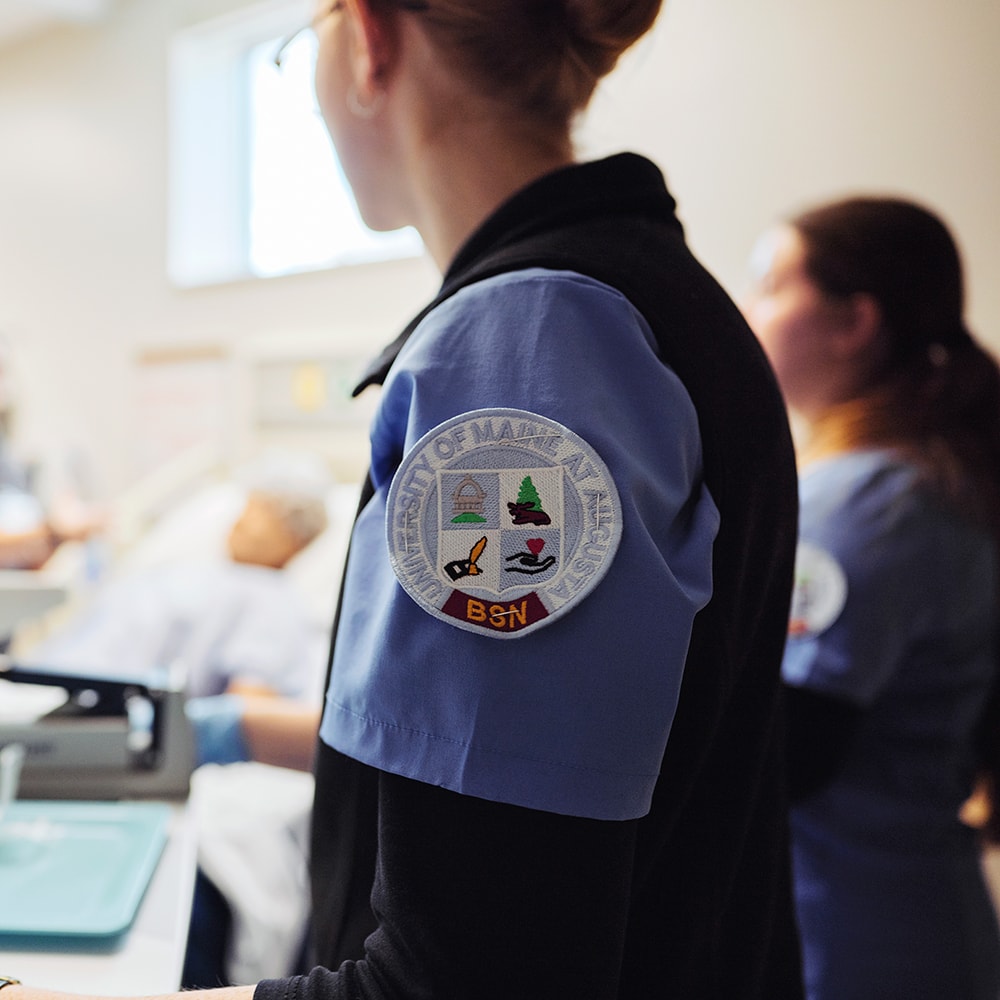
uma nursing student wearing uma nursing sleeve patch

“We are committed to nurturing the growth of compassionate professional nurses who will embody the values of holistic caring—using their wisdom, heart, and soul to make a difference.”

Where empathy meets expertise

UMA’s nursing faculty are the essence of the program. Every faculty member is doctorally prepared, or are enrolled in doctorate programs. They act as role models for care and self care, preparing students to be resilient leaders in a stressful healthcare landscape. They apply the philosophy of relationship-centered care to their teaching, creating a rigorous, yet supportive learning environment.

FAQs

Yes, UMA’s RN-to-BSN completion program is 100% online and asynchronous.

UMA’s RN-to-BSN Completion path is a 2-year program with flexible pacing, so you can advance on your schedule. UMA offers credit for prior learning and experience [link], so some credits may be able to be waived.

The University of Maine at Augusta (UMA)’s RN-to-BSN Completion program requires that students already hold an associate’s degree in nursing or another nursing degree. The 2-year program is designed for students to pick up where they left off with their initial degree, and work toward their Bachelor’s of Science in Nursing (BSN). Students can gain additional credits for their professional experience through the following pathways:

  • External Certifications (Credential Review): If you are already a working nurse or hold specialized healthcare certifications, UMA can evaluate them for academic credit. For instance, students in the nursing program can be awarded 3 NUR elective credits for holding an active, approved national nursing certification.
  • National League for Nursing (NLN) Exams: UMA explicitly accepts specific NLN tests. These standardized exams allow you to demonstrate nursing proficiency and bypass certain course requirements.
  • Academic portfolio assessment: If you have extensive workplace or life experience that matches the learning objectives of a specific UMA course, you can compile an academic portfolio. A UMA faculty member will review your written narrative and evidence (like work projects, training certificates, or professional logs) to determine if credit can be awarded.
  • Departmental challenge exams: If you already know the material for a course but don’t have an official transcript or certification for it, you can request a Challenge Exam. Faculty-created exams exist for specific prerequisites, such as ENG 210W (Writing for Allied Health) and CIS 100 (Introduction to Computing). Taking and passing a challenge exam costs $100.
  • Standardized exams (CLEP, DSST, AP): You can test out of many general education or introductory science requirements. UMA is an official testing center for CLEP and DSST exams.
  • Military training: Active-duty military personnel and veterans can submit their Joint Services Transcript (JST). UMA awards credit based on the American Council on Education (ACE) guidelines for military occupations and training.

Important policies to keep in mind

  • GPA impact: Earning credit through CPL will not impact your cumulative GPA in any way. It is strictly recorded as transfer/prior learning credit.
  • Residency requirements: To graduate from UMA, you must complete a certain number of credits directly through the university (residency). Credits earned from external exams (like CLEP or DSST) or external credential reviews do not count toward your residency requirement. However, Challenge Exams and Portfolios evaluated directly by UMA faculty do count toward residency.
  • Matriculation: You must be officially admitted and matriculated into a degree-seeking program at UMA before CPL credits can be formally applied to your transcript.

Absolutely! The RN-to-BSN Completion program is 100% online, asynchronous, and designed for working nurses. You can advance through the program at the pace that works best for your schedule. 

Yes, absolutely. Completing the RN-to-BSN program at the University of Maine at Augusta (UMA) qualifies you to apply for graduate-level nursing programs, including a Master of Science in Nursing (MSN), a Doctor of Nursing Practice (DNP), or a Ph.D. in Nursing.

  • Programmatic accreditation: UMA’s Bachelor of Science in Nursing program (both the 4-year Prelicensure BSN and the RN-to-BSN Completion paths) is fully accredited by the Accreditation Commission for Education in Nursing (ACEN). Graduate schools generally require applicants to hold a BSN from a nationally accredited program.
  • Regional institutional accreditation: UMA is regionally accredited by the New England Commission of Higher Education (NECHE). This ensures that your degree and credits will be recognized by other higher education institutions across the country.
  • Built-in graduate prerequisites: Most graduate nursing programs require a college-level statistics course and a nursing research course. UMA’s RN-to-BSN Completion curriculum explicitly includes MAT 115 (Elementary Statistics I) and NUR 352 (Nursing Research), meaning you won’t have to take these as standalone prerequisites later.

While the degree itself qualifies you, graduate programs are competitive. Keep these standard graduate admission factors in mind while finishing your BSN at UMA:

  • Maintain a strong GPA: While UMA requires a 2.5 GPA to enter the RN-to-BSN program, most MSN and DNP programs look for a cumulative undergraduate GPA of 3.0 or higher for competitive admission.
  • Clinical experience: Many nurse practitioner (NP) or other advanced practice graduate tracks require 1 to 2 years of active bedside clinical experience as an RN before you can begin clinical graduate courses.
  • Build relationships for recommendations: Graduate programs typically require 2-3 professional letters of recommendation. Take time to build strong relationships with your UMA nursing professors and clinical supervisors.

Have questions?

TruLeague connects you directly with current UMA nursing students, faculty, and alumni so you can get honest, real-time answers about the program. Chat one-on-one to discover what coursework and clinicals are really like, so you can feel confident taking your next step into nursing.