
President Jenifer Cushman shared UMA’s direction for the year ahead as colleagues welcomed new employees and celebrated years of service to the university.
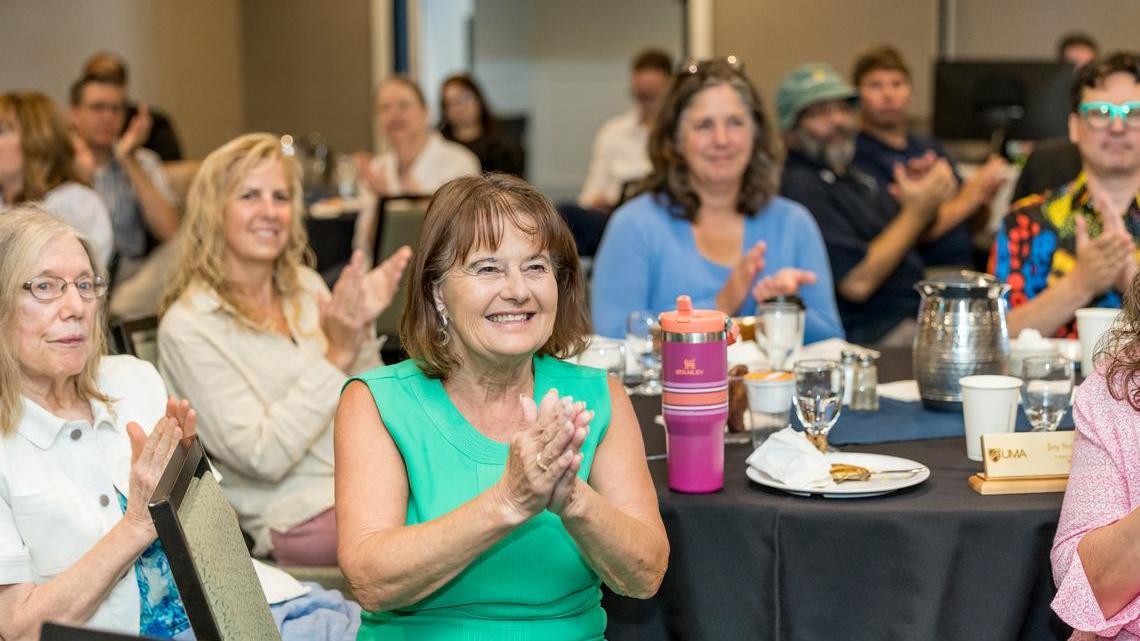
Faculty and staff gathered in Augusta and Bangor on Friday, Aug. 28, for UMA’s annual Welcome Back Breakfast.
The morning marked the start of the 2026-27 academic year and offered a chance to welcome new colleagues and recognize employees reaching service milestones. President Cushman used her remarks to talk about where UMA is headed and the role faculty and staff have in moving that work forward.
Jump to President Cushman’s full Welcome Back Breakfast remarks.
A clear direction for UMA
At the center of Cushman’s remarks was the future outlined in UMA’s strategic plan, Building a Sustainable Future Through Access and Innovation.
“We are building a university that is more visible, more connected and more responsive to Maine.”
For UMA, that means strengthening the residential experience for traditional-age students while continuing to serve working adults, transfer students, online learners, veterans and others who need a more flexible path to a degree.
It also means helping more students stay at UMA and finish their degrees, keeping academic programs responsive to Maine’s changing economy, and building stronger relationships with employers and communities.
Several of the examples Cushman shared came from the past academic year. UMA received a record number of housing applications, and plans for a new residence hall in Hallowell are moving forward.
The Early College program became the first in Maine to earn national NACEP accreditation, and the Dental Assisting program received the highest accreditation status available from CODA. UMA biology students conducted research at the MDI Biological Laboratory, every graduate in the 2026 Veterinary Technology class passed the national examination on the first attempt, and allied dental graduates achieved perfect board-exam results.
Cushman also recognized the 20th anniversary of UMA’s Prison Education Partnership and new federal approval that will allow the university to bring college courses and degree pathways to more incarcerated students across Maine.
“Whatever route brought them to UMA, they are trusting us to help them earn a degree, advance their careers, and create greater opportunities for themselves and their families,” Cushman said. “That trust should be at the center of the year ahead.”
Staying connected
Cushman said faculty and staff will have more opportunities to hear from leadership, ask questions and share their perspectives throughout the year.
“We may not always agree, and some decisions will still be difficult, but I want us to move through them with greater clarity, respect and trust,” she said.
Dates for this fall’s Town Halls and Java with Jen conversations will be shared in next week’s Monthly Moose News.
Recognizing years of service
The morning also celebrated employees who have spent years teaching and advising students, building programs, supporting colleagues and helping UMA through periods of change.
“A strategic plan alone does not move a university forward. People do,” Cushman said.
Photos from the Welcome Back Breakfast will be included in next week’s Monthly Moose News.
President Cushman’s Welcome Back Breakfast remarks
As prepared for delivery | Aug. 28, 2026
Good morning, everyone, and welcome back.
What a beautiful day on which to gather and celebrate our community! Everything looks lovely, and for this we need to thank our Welcome Back Committee: Carolyn Anderson, Kristen Eaton, Kris Albert, Elizabeth Glover, Pam Goding, Frear Hook Jamie Spadea, and Jeff Sychterz; Jesse Keefe- Augusta photography and Rene Day – Bangor photography; our AV team: Greg Keneborous, Rick Burns, Robert Sobczak, and Peter Starkey; Sodexo, and Jeff’s Catering.
We would like to begin by respectfully acknowledging the Wabanaki Nations一the Penobscot, Passamaquoddy, Maliseet, and Mi’kmaq一who have stewarded the land on which we gather for countless generations and continue to do so today.
We recognize that the University of Maine at Augusta’s campuses and Centers are located in the homeland of these Tribal Nations. We acknowledge the historical and ongoing impacts of colonization and affirm our commitment to building and sustaining respectful relationships with Wabanaki communities.
Through education, community engagement, and institutional collaboration, we seek to honor Wabanaki cultures, histories, and contributions. We are committed to fostering Indigenous representation in education and cultivating partnerships grounded in respect and reciprocity.
It is wonderful to see so many colleagues here in Augusta, and I also want to welcome everyone joining us from Bangor.
Yesterday, we welcomed students as they moved into campus housing. Next week, they will be joined by classmates on our campuses, at our Centers, and online across Maine and beyond. For some, it will be their first day of college, for them, and sometimes in their families. Others will be returning after time away or balancing classes with work and family.
Whatever route brought them to UMA, they are trusting us to help them earn a degree, advance their careers, and create greater opportunities for themselves and their families. That trust should be at the center of the year ahead.
As we begin this academic year, I want to be clear about where UMA is going.
When I arrived at UMA three years ago, I spent my first semester listening to faculty, staff, students, and community partners. I heard pride in what UMA already does well and a shared belief that more people should understand the value this university brings to Maine. I heard about our strengths in access, flexibility, educational technology, and workforce development, along with opportunities to build on them.
Those conversations still guide me. UMA is already doing much of what higher education needs to do today. Our responsibility now is to build on those strengths, engage our alumni and donors, bring the opportunity of a UMA education within reach of even more students, and celebrate publicly the good things we are doing.
Our strategic plan, Building a Sustainable Future Through Access and Innovation, gives us that direction. We are building a university that is more visible, more connected, and more responsive to Maine. That means expanding the ways people can enter college, helping more students stay on track and earn their degrees, reaching out better to engage our alumni, and ensuring that a UMA education prepares graduates to strengthen the workplaces and communities that depend on them.
At UMA, that includes creating a stronger residential experience for traditional-aged students while continuing to provide flexible, high-quality pathways for working adults, transfer students, online learners, veterans, and students whose lives do not fit a traditional college model.
We can already see this direction taking shape.
More traditional-aged students are choosing UMA. We’ve received a record number of housing applications and the planned residence hall in Hallowell reflects the growing demand for a fuller traditional student experience.
This past academic year brought clear signs of academic quality across UMA.
Our Early College program became the first in Maine to earn national NACEP accreditation, and our Dental Assisting program received the highest accreditation status available from CODA.
UMA biology students conducted research at the MDI Biological Laboratory and presented their findings at a statewide scientific symposium.
Every graduate in our 2026 Veterinary Technology class passed the national examination on the first attempt, while our allied dental graduates achieved perfect board-exam results and entered the workforce with job offers already in hand.
As our Prison Education Partnership marks its 20th anniversary, new federal approval will allow UMA to bring a college education to more incarcerated students across the state. I want to mention that our service award gifts were made at the Maine Correctional Industries, as part of our strong, continuing relationship with the Maine Dept of Corrections.
These are only a few examples of the work happening across UMA. In every college, at every location, and in every mode, faculty and staff are opening doors for students, strengthening academic programs, and connecting a UMA education to the needs of Maine.
Our priorities are clear. We need to help more students stay at UMA and finish their degrees, and we need to keep our programs responsive to a changing economy. Stronger relationships with employers, communities, alumni, and donors will help us do both. Since I arrived at UMA, this has been my priority: to expand our view, to professionalize our storytelling with marketing and communications, and to build a robust advancement and alumni relations program that helps our alumni engage better, and brings in resources for our strategic initiatives. This clear vision relates specifically to our 4th and 5th strategies: enhance marketing and recruitment and cultivate reputation and resources.
I must acknowledge that last year was difficult for many of us across UMA. It strained relationships and raised important questions about how we communicate, how we respect one another, and how decisions are made.
I have spent time over the summer reflecting on that. I believe there were times when I could have communicated earlier, explained the context for decisions more clearly, and created more room for input. I understand the frustration and uncertainty that created.
I believe we can work together. This year I’ll be encouraging conversations and seeking out dialogue opportunities about how to do so. I will continue to hold formal and informal opportunities for communication, including town halls, Javas with Jen, and regular written updates. I want those conversations to help us surface questions earlier, understand different perspectives, and keep moving forward together.
We may not always agree, and some decisions will still be difficult, but I want us to move through them with greater clarity, mutual respect, and trust.
Because a strategic plan alone does not move a university forward, especially in these difficult times for higher education. People do. And we have amazing people at UMA!
Many of the colleagues we recognize this morning have helped UMA through years of change. They have taught and advised students, built programs, solved problems, supported their colleagues, and kept this university moving forward.
As we present our service awards, I hope we will celebrate more than the number of years these employees have given UMA. Their real impact can be seen in the students they have helped, the programs they have strengthened, and the university they have helped us become.
UMA graduates are everywhere in Maine because of the work that begins here, with all of you.